
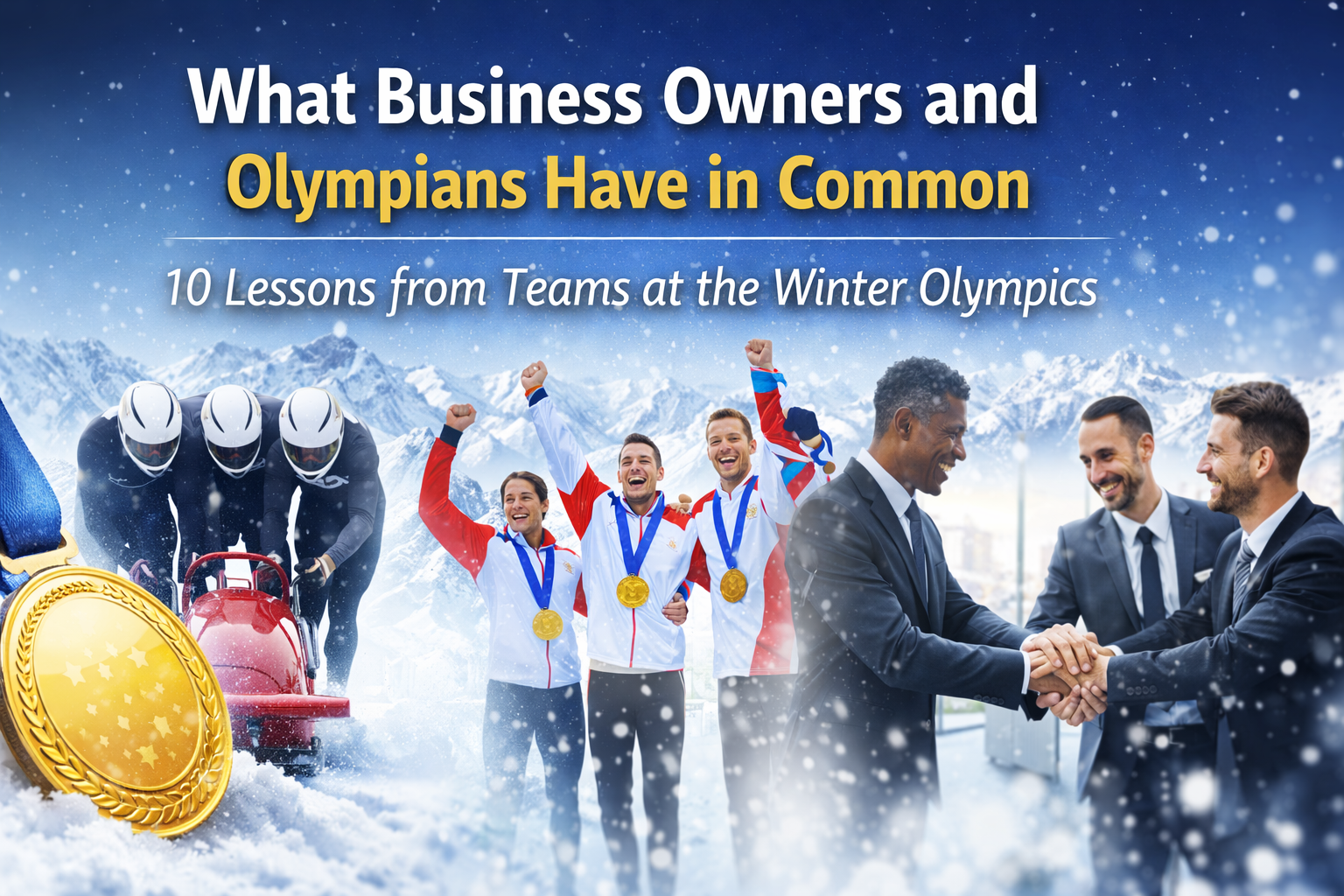

What Business Owners and Olympians Have in Common: 10 Lessons from Teams at the Winter Olympics
What Business Owners and Olympians Have in Common: 10 Lessons from Teams at the Winter Olympics
Every four years, the world watches – I know I watched! – elite athletes compete on ice and snow with breathtaking precision. They showed clips of athletes preparing for the 2026 Winter Olympics, and winter athletes reminded me of something powerful: Behind every medal is a team operating like a high-performance business.
While Olympians train for sport and business owners build companies, the attributes required for both are remarkably similar. Here’s what the Winter Olympic teams teach us about succeeding in business.
- Vision: Competing for the Gold
Every Olympic team begins with a clear objective: stand on the podium. In business, the equivalent is defining your North Star:
|
Every Olympic team begins with a clear objective: stand on the podium. In business, the equivalent is defining your North Star:
|
Olympic teams don’t vaguely hope to “do well.” They train for a specific outcome. Business owners who succeed do the same. They articulate measurable goals and align their teams around them.
Lesson: A clear, shared vision transforms effort into coordinated momentum.
- Role Clarity: Everyone Has a Position
Consider team sports like ice hockey, curling, or bobsledding. Each athlete has a precise role:
If one person oversteps—or underperforms—the entire team suffers. |
High-performing companies mirror this structure:
Confusion over roles in business creates friction, just like a mistimed push at the start line. |
Lesson: Excellence requires knowing your lane—and mastering it.
- Trust Under Pressure
Winter Olympic events are often decided by fractions of a second. Athletes must trust:
|
In business, pressure looks different:
|
When adversity hits, trust becomes the glue. Teams that hesitate, second-guess, or protect ego instead of outcomes fall apart.
Lesson: Trust is built in preparation, revealed in pressure.
- Relentless Preparation
|
Likewise, business growth doesn’t happen at the moment of opportunity—it happens in the quiet seasons:
|
By the time opportunity appears, prepared businesses are ready to execute.
Lesson: Success is earned long before it is seen.
- Agility and Adaptation
| Winter conditions are unpredictable. Ice changes. Weather shifts. Equipment behaves differently.
Winning teams adapt instantly. |
In business, conditions shift just as quickly:
|
Rigid teams struggle. Agile ones pivot, adjust, and recalibrate.
Lesson: The ability to adjust mid-course is often the difference between surviving and winning.
- Resilience After Failure
| Many Olympians fail publicly before they ever win. Falls, missed shots, narrow defeats—these moments are broadcast worldwide. | Business owners experience similar setbacks:
|
The difference between average and elite—both in sport and business—is resilience. They review performance, refine strategy, and return stronger.
Lesson: Failure is feedback, not finality.
- Coaching and Advisory Support
No Olympic team competes alone. Behind every athlete is:
|
Similarly, thriving businesses rely on:
|
Elite performers understand something many entrepreneurs resist: excellence requires outside perspective.
Lesson: Even the best need guidance.
- Culture of Accountability
| In Olympic teams, accountability is immediate and visible. If one member misses timing, everyone feels it. | In business, accountability must be intentional:
|
Strong cultures don’t tolerate blame—they encourage responsibility.
Lesson: High standards create high performance.
- Emotional Discipline
Olympians must regulate emotion:
|
Business leaders face similar emotional demands:
|
Emotional maturity is a competitive advantage in both arenas.
Lesson: Mastering yourself is as important as mastering strategy.
- Long-Term Commitment
| Olympic glory may last minutes. Preparation lasts years. | Business success works the same way. Sustainable companies aren’t built in quarters; they’re built over decades.
The entrepreneurs who endure:
|
Lesson: Endurance outperforms bursts of intensity.
Building Your Own Gold-Medal Team
The teams we watch at the Winter Olympics are not just athletes. They are case studies in:
- Leadership
- Collaboration
- Discipline
- Strategic execution
Business owners who adopt these Olympic attributes position themselves not merely to compete—but to win.
The real question is not whether you have talent.
It’s whether you are building your company like an Olympic team:
- With vision
- With structure
- With accountability
- With trusted advisors
- With relentless preparation
Because in business—just like in the Winter Games—success belongs to teams who prepare for greatness long before the world is watching.